

Poor sleep rarely comes from one simple cause. Explore seven common patterns and find the most sensible place to start improving your sleep.

You can feel exhausted all day and still become strangely alert when your head touches the pillow.
Sometimes your mind starts replaying conversations, planning tomorrow, or revisiting something embarrassing from years ago. On other nights, you fall asleep without much trouble but keep waking, sleep lightly, or reach morning wondering how eight hours in bed managed to feel like four.
The frustrating part is that poor sleep rarely arrives with a helpful label.
You may blame stress when the real problem is late caffeine. You may blame your phone when pain keeps pulling you out of deeper sleep. You may assume you are simply “bad at sleeping” when your schedule changes so often that your body no longer knows when night begins.
More than one factor may be involved, which is why trying to fix everything at once usually creates more frustration than clarity.
A better place to start is to identify the pattern that sounds most like your experience. Once you know what deserves attention first, you can make one useful change and see how your sleep responds.
Quick answer: Common reasons you may struggle to sleep include stress, late caffeine, an irregular schedule, an uncomfortable sleep environment, breathing problems, physical discomfort, and evening habits such as alcohol or heavy meals. The right first step depends on whether you struggle to fall asleep, stay asleep, or feel restored the next morning.
First, Notice What Kind of Sleep Problem You Have
“Why can’t I sleep?” can describe several different experiences.
You may struggle to fall asleep in the first place. You may wake repeatedly during the night, wake too early, or sleep for long enough without feeling restored. These patterns can overlap, but the distinction matters because they often point towards different starting places.
Use this table as a quick guide:
| What you notice | A sensible place to look first |
|---|---|
| Your body feels tired, but your mind remains busy | Stress, worry, or bedtime habits |
| You feel alert after an afternoon coffee or energy drink | Caffeine timing and total dose |
| You sleep much later on weekends | An irregular sleep schedule |
| Noise, heat, light, or notifications wake you | Your bedroom environment |
| You snore loudly, gasp, or wake with headaches | Possible breathing disruption |
| Pain or an urge to move your legs keeps interrupting sleep | Physical discomfort or restless legs |
| You fall asleep quickly after drinking but wake later | Alcohol and evening habits |
This is not a diagnostic tool. It is a way to stop treating every sleep problem as though it has the same cause.
Before changing anything, it may also help to keep a simple sleep diary for one or two weeks. Record when you go to bed, how long sleep seems to take, how often you wake, when you consume caffeine or alcohol, and how you feel the next morning. Sleep specialists often use this same information because patterns are easier to understand when they are written down.
1. Stress, Worry, and a Mind That Will Not Settle
Your body may be ready for sleep while your mind is still trying to finish the day.
You replay something that happened at work. You plan tomorrow’s tasks. You worry about money, family, health, or a problem that feels far more urgent at 2:00 AM than it did at lunchtime.
This does not mean you are choosing to stay awake. Stress keeps your nervous system alert, while worrying about sleep can add another layer of pressure. The more often you check the time and calculate how little sleep remains, the harder it may become to settle. Stress, anxiety, major life events, and fear about not sleeping are all recognized contributors to insomnia.
What this pattern can feel like
- Your thoughts become louder when the room becomes quiet.
- You repeatedly check the clock.
- Your jaw, shoulders, or stomach feel tense.
- You wake during the night and immediately begin thinking.
- You feel exhausted, yet mentally switched on.
What to try first
Create a short closing routine before bed.
Spend five or ten minutes writing down unfinished tasks, tomorrow’s priorities, or anything you are worried about forgetting. You are not trying to solve your entire life in a notebook. You are simply giving your mind somewhere to place the information.
After that, choose one quiet activity that helps you step away from the day. Reading, slow breathing, gentle stretching, or listening to something calm can all work. The routine does not need to be long or impressive; it needs to be easy enough to repeat.
It also helps to keep stressful work out of bed. When emails, spreadsheets, arguments, and late-night planning regularly happen under the duvet, your brain begins to associate the bed with activity rather than rest.
Persistent anxiety, low mood, or intrusive thoughts deserve proper support, especially when they affect the rest of your day. Sleep advice can help around the edges, but it cannot replace mental health care when the underlying problem needs more attention.ally when it affects daily life.
2. Caffeine That Arrives Too Late in Your Day
Your cup may be empty, but your body may still be processing what was inside it.
Caffeine blocks part of the natural sleep pressure that builds while you are awake. Its effects can last for hours, which means coffee, tea, cola, energy drinks, pre-workout supplements, chocolate, and some medicines may affect your night long after the obvious buzz has worn off.
Official healthy-sleep guidance notes that caffeine can interfere with sleep for up to eight hours. However, personal sensitivity and dose vary, so one universal cutoff will not suit everyone.
What this pattern can feel like
- You take longer than usual to fall asleep.
- You feel tired but oddly alert.
- Your sleep feels light or restless.
- You wake several times without knowing why.
- You need more caffeine the following day.
That final point can create an unhelpful cycle. Poor sleep leads to more caffeine, while more caffeine makes the next night harder.
What to try first
Move your last caffeine earlier for seven days.
A sensible first test is to stop six to eight hours before your usual bedtime. Keep the rest of your routine reasonably stable, then note whether you fall asleep more easily, wake less often, or feel more refreshed.
Remember to count all sources, not only coffee. A mid-afternoon energy drink or evening pre-workout may contain far more caffeine than the morning cup receiving all the blame.
For a deeper explanation and a complete seven-day test, read our guide to caffeine and sleep.
3. An Irregular Sleep Schedule
Your body does not use bedtime alone to decide when sleep should happen.
It follows an internal rhythm shaped by light, activity, meals, and the times you usually sleep and wake. When those signals change from day to day, your body may struggle to feel alert and sleepy at the right moments.
This often happens with shift work, travel, childcare, social weekends, or working hours that change regularly. Sleeping late on free days may feel like a sensible way to recover, but a large shift can leave Sunday night feeling like mild jet lag.
Your sleep-wake cycle follows a roughly 24-hour rhythm, and both light exposure and sleep timing help keep that rhythm aligned.
What this pattern can feel like
- You become sleepy at very different times.
- You struggle to wake on workdays.
- You sleep several hours later on weekends.
- Sunday evening sleep feels unusually difficult.
- You feel jet-lagged without having traveled.
What to try first
Start with your wake time rather than forcing an earlier bedtime.
Aim to get up at roughly the same time each day, including after a poor night. You do not need minute-perfect consistency, and real life will sometimes interfere. However, a recognizable pattern gives your body a clearer signal than a schedule that changes by several hours.
Morning or daytime light can also help reinforce that signal. Open the curtains, spend some time outside, and avoid spending the first half of the day in a dim room.
When you need to move your schedule, make the change gradually. Asking your body to sleep two hours earlier simply because you have decided it should rarely produces a peaceful evening.
Shift workers may not be able to keep the same sleep period every day. In that case, protect the most consistent sleep window your work pattern allows and keep caffeine towards the earlier part of your shift.
4. Light, Noise, Temperature, and a Bedroom That Keeps You Alert
Sometimes the problem is not your mind or your habits. It is the room around you.
Street noise, a warm bedroom, early sunlight, an uncomfortable mattress, or a partner’s movements can repeatedly disturb sleep. Even small disruptions matter when they happen throughout the night.
Phones add another layer because they combine light with content designed to hold your attention. The screen may be part of the problem, but so are the messages, videos, news, and unexpected comment-section drama arriving when your brain needs fewer reasons to stay awake.
Bright evening light can interfere with the sleep-wake cycle, while official sleep guidance recommends keeping the bedroom quiet, cool, and dark.
What this pattern can feel like
- You continue scrolling long after your intended bedtime.
- You wake because the room feels hot or stuffy.
- Street noise or household sounds disturb you.
- Light enters through the curtains early.
- You check notifications whenever you wake.
What to try first
Remove the most obvious source of friction.
That may mean using thicker curtains, earplugs, gentle background sound, lighter bedding, or a fan. If your phone regularly keeps you awake, charge it beyond easy reach and use a separate alarm if needed.
You do not need to turn your bedroom into a silent wellness retreat. The aim is simply to make sleep easier than staying awake.
Comfort matters as well, although an expensive bedroom makeover should not be the automatic first step. Begin with the problem you can clearly identify before replacing furniture in the hope that better sleep arrives with the delivery van.

5. Snoring or Breathing That Becomes Disrupted During Sleep
Snoring is common and does not always mean something serious.
However, loud snoring deserves more attention when it appears alongside breathing pauses, gasping, choking, repeated waking, morning headaches, or strong daytime sleepiness. These can be signs of obstructive sleep apnoea, where the airway repeatedly narrows or closes during sleep.
People often do not know this is happening because the clearest symptoms occur while they are asleep. A partner may notice the breathing pauses before the person experiencing them does. Current NHS and NHLBI guidance recommends medical assessment when breathing stops and starts, gasping or choking occurs, or daytime tiredness remains severe.
What this pattern can feel like
- Loud, regular snoring
- Gasping, choking, or snorting during sleep
- Someone noticing pauses in your breathing
- Waking with a dry mouth or headache
- Feeling extremely sleepy despite spending enough time in bed
- Difficulty concentrating during the day
What to do first
Ask someone who has heard you sleep whether they have noticed pauses, gasping, or choking.
Then speak with a healthcare professional or GP. A proper assessment may include questions about your symptoms and, when needed, a sleep study. An online article, app, watch, or questionnaire cannot diagnose sleep apnoea.
This is also not the best moment to buy a collection of anti-snoring gadgets and hope one happens to treat the right problem. Assessment comes first because the treatment depends on what is actually happening.
Do not drive when you are struggling to stay awake. Excessive sleepiness affects attention and reaction time, and untreated sleep apnoea can increase accident risk.
6. Pain, Reflux, Physical Discomfort, or Restless Legs
Deep sleep is difficult when your body keeps asking you to move.
Back pain, joint discomfort, headaches, reflux, temperature changes, and other physical symptoms can repeatedly bring you closer to wakefulness. You may remember some awakenings, while others are brief enough to disappear by morning.
Restless legs syndrome has a more specific pattern. It usually involves a strong urge to move the legs, often with sensations described as tingling, throbbing, itching, aching, or pulling. Symptoms tend to become worse during rest and at night, and movement may bring temporary relief.
What this pattern can feel like
- You cannot find a comfortable sleeping position.
- Pain repeatedly wakes you.
- Your legs feel uncomfortable when you lie still.
- The sensations become worse in the evening.
- Walking, stretching, or moving helps briefly.
- Reflux or stomach discomfort appears after lying down.
What to try first
Keep a short record of when the symptoms appear and what seems to affect them.
For pain, note the location, sleeping position, activity, and whether the discomfort is new or worsening. For restless legs, record when the sensations begin, whether movement helps, and whether caffeine, alcohol, or medication appears connected.
Gentle stretching, walking, massage, or a warm bath may ease restless legs for some people. However, persistent symptoms deserve medical attention because restless legs can sometimes be associated with iron deficiency, pregnancy, kidney disease, or medication effects. A clinician can investigate the cause rather than asking you to guess or begin supplements on your own.
The same principle applies to ongoing pain and reflux. Improving your pillow or sleeping position may help, but symptoms that continue, worsen, or regularly prevent sleep need more than another round of bedroom adjustments.
7. Alcohol, Heavy Meals, and Evenings That Never Quite End
Alcohol can make you feel sleepy, which is why it is easy to mistake sedation for good sleep.
You may fall asleep faster after drinking, yet sleep can become more fragmented later in the night. Alcohol can also lead to earlier waking and may worsen sleep-related breathing problems. NIAAA guidance notes that even moderate doses can alter sleep, while people commonly experience broken sleep and earlier waking after drinking.
Heavy meals can create a different problem. Lying down soon after eating may bring discomfort, fullness, or reflux, while large late meals give your body more work when you are trying to settle.
Then there is everything else that happens before bed: late work, intense gaming, upsetting news, arguments, and endless scrolling. None of these activities is automatically forbidden, but they can leave your mind carrying daytime speed into the bedroom.
What this pattern can feel like
- You fall asleep quickly after drinking but wake later.
- You feel hot, thirsty, or restless during the night.
- You wake earlier than planned.
- Heartburn or stomach discomfort appears in bed.
- Your mind remains activated after work, news, or gaming.
- You wake feeling unrefreshed after an evening drink.
What to try first
Compare your sleep on drinking and alcohol-free nights. Look at the whole night rather than only how quickly you fall asleep.
It may also help to leave more space between a large meal and bedtime, particularly when reflux or discomfort is part of the pattern.
Finally, create a recognizable end to your day. Lower the lights, stop working, prepare what you need for tomorrow, wash or shower, and choose something calmer for the final part of the evening.
Your routine does not need to look impressive. It only needs to help your body understand that the active part of the day is over.
Your Sleep Problem May Be a Chain, Not One Cause
You may have recognize yourself in several sections, and that is often where the real picture begins.
Stress can lead to late-night scrolling. The later bedtime leaves you exhausted in the morning, so you reach for more caffeine. That caffeine carries into the evening, making it harder to settle the following night.
Alcohol may help you fall asleep, but the broken sleep that follows leaves you tired the next day. You nap in the afternoon, then struggle to feel sleepy at your normal bedtime.
Sleep problems often reinforce one another in this way. As a result, the most visible habit is not always the best place to begin.
Instead of attacking all seven causes at once, ask three questions:
- Which pattern sounds most like my nights?
- Which concern carries the greatest health or safety risk?
- Which one change could I realistically test this week?
Breathing pauses and dangerous daytime sleepiness need professional attention first. For less urgent patterns, begin with the change that is easiest to observe.
A Simple Seven-Night Starting Plan
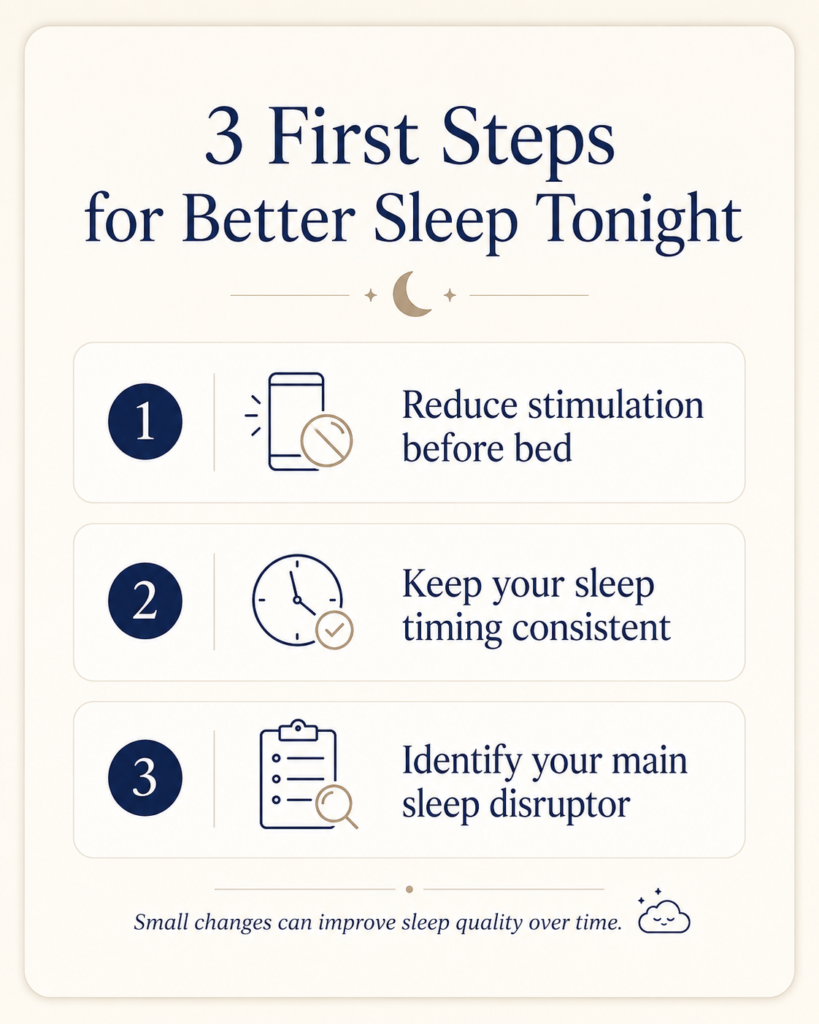
You do not need a complete sleep transformation tonight.
For the next seven nights, choose one pattern and change one relevant behavior. Keep the rest of your routine as stable as real life allows.
Record:
- When you went to bed
- Roughly how long sleep took
- How often you remember waking
- When you woke for the day
- Caffeine and alcohol timing
- Any pain, leg symptoms, or breathing concerns
- How rested and alert you felt the next day
After one week, review the pattern rather than judging individual nights.
One poor night does not prove the experiment failed. In the same way, one unusually good night does not prove you have solved the problem. You are looking for a direction of travel.
When Better Sleep Habits Are Not Enough
Healthy sleep habits can remove common obstacles, but they are not a complete treatment for every sleep problem.
Chronic insomnia usually means difficulty falling asleep, staying asleep, or getting good-quality sleep at least three nights a week for three months or longer. When that pattern affects daily life, proper assessment matters.
Cognitive behavioural therapy for insomnia, usually called CBT-I, is commonly recommended as the first treatment for long-term insomnia. It goes beyond basic sleep tips by addressing the thoughts and behaviours that keep insomnia going.
This distinction matters because people with persistent insomnia often respond by trying harder. They create stricter routines, buy more supplements, and become increasingly anxious about doing sleep correctly.
At that point, you may not need more discipline. You may need treatment designed for the problem you actually have.
When Should You Speak With a Healthcare Professional?
Seek medical advice when:
- Your sleep problems have continued for several months.
- Poor sleep is affecting your work, mood, relationships, or daily functioning.
- You frequently fall asleep unintentionally.
- You snore loudly and someone notices breathing pauses.
- You wake gasping, choking, or short of breath.
- You regularly wake with headaches and strong daytime tiredness.
- Pain, reflux, or leg symptoms repeatedly prevent sleep.
- You think a medicine or health condition may be affecting your sleep.
- Your sleepiness makes driving or operating machinery unsafe.
Do not drive when you cannot stay alert.
Persistent sleep problems are not a personal failure, and they are not always solved by improving your bedtime routine. Sometimes the most useful next step is asking someone qualified to help you understand what is happening.
The Bottom Line
You do not need another list of perfect sleep habits.
You need a clearer idea of what is disturbing your sleep and one sensible place to begin.
Perhaps your mind needs a gentler end to the day. Perhaps your caffeine cutoff needs to move earlier. Your schedule or bedroom may need more consistency, while snoring, pain, or restless legs may deserve professional attention.
Choose the pattern that fits best. Test one realistic change for seven nights, then look at the overall result.
You are not trying to become perfect at sleeping. You are trying to understand what your nights have been telling you.
The free Mindsura Sleep Pattern Check can help you identify which pattern deserves your attention first. It takes around 60 to 90 seconds and gives you a practical starting point based on your answers.
Take the free Mindsura Sleep Pattern Check.
Medical disclaimer: This article provides general educational information and does not replace medical advice, diagnosis, or treatment. Speak with a qualified healthcare professional about persistent insomnia, severe daytime sleepiness, breathing problems during sleep, medication concerns, or other symptoms that worry you.